

Why Should Eggs Be Stored with the Pointed End Down?
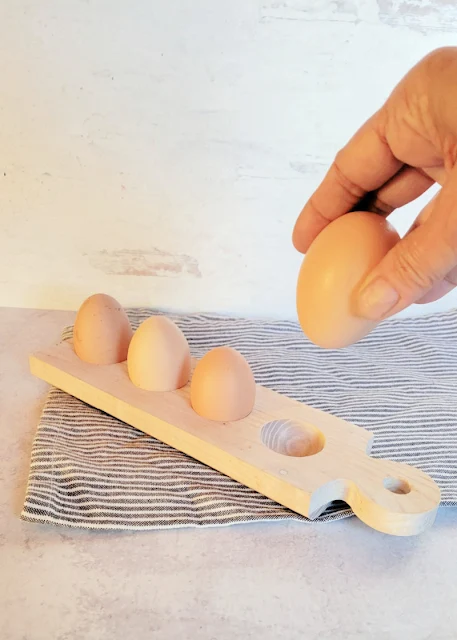
Did you know that eggs should always be stored with the pointed end facing down? And there's a very good reason for that.

Why Should Eggs Be Stored with the Pointed End Down?
Before I explain why eggs should always be stored with the pointed end down, let's back up a bit.
When an egg is being formed and laid, there is a narrow, pointed end and a more rounded, blunt end on each egg.
A Softer Landing for the Egg
As the egg travels down the oviduct, it travels with the pointed end first.
The egg also spins and rotates as it travels, almost like a bullet travelling down the barrel of a gun.
Just before the hen lays her egg, she stands up a bit in the nest, holding a squatting position, and the egg flips around so that it's laid blunt end first.
This makes for a better, more cushioned landing for the egg, and less likelihood that the egg will break as it exits the hen's body.

There's Also an Air Sac in an Egg
There is also an air sac at the blunt end of every egg.
It's this sac that an incubating chick embryo will use for air to breathe once its lungs are developed, but before it has hatched and is breathing outside air.
As an egg ages, whether fertile or not, the air sac will expand and get larger as air is allowed through the eggshell pores and moisture is allowed to escape.
There's a natural "bloom", an invisible coating, on the egg that helps prevent air and bacteria from entering the egg.
(Preserving that bloom is one reason why eggs should not be washed until just before using them.)

The egg white (or albumen) provides a layer of protection for the yolk. Since the egg white is alkaline, it's difficult for bacteria to thrive or grow in the egg white. The yolk is the more perishable part of an egg.
However, as an egg ages, the bacteria will start to multiply and move towards the nutrient-rich yolk where they can flourish. Also as the egg ages, the air sac grows which allows bacteria to move closer to the yolk.
So Here's Why Should Eggs Be Stored with the Pointed End Down
When an egg is stored with the pointed end up, with the air sac positioned at the bottom of the egg, that sac which is filled with air that is lighter than the egg yolk and white,will slowly rise and move towards the yolk, bringing any bacteria with it and risking contaminating the egg yolk.
That will increase the likelihood that salmonella or other bacteria will reach the yolk more quickly and contaminate the egg.
And there's also the chance that the air sac will rupture and contaminate the egg with any bacteria it contains.
That will also hasten the 'aging' process of the egg, making it less 'fresh' since keeping the yolk completely enclosed within the white protects the yolk from drying out.

By storing the egg with the pointed end down, the air sac remains at the top of the egg (the blunt end) where it belongs. It's lighter than the egg contents, so it safely sits on top.
Also more of the white, which is mostly made up of water and from where moisture evaporates, is sitting in the carton and not exposed to quite so much air, and therefore loses moisture more slowly.
Another benefit to storing your eggs pointy end down is that if you're making deviled eggs, the yolks will be centered, which makes for easier eating and a more attractive deviled egg!

So to sum it up:

Do As I Say, Not What I Do!
That being said, I guess I don't always practice what I preach! Since we use our eggs so quickly and they are "coop to kitchen" fresh, I don't worry so much and usually keep a bowl of eggs on the kitchen counter, all topsy-turvy.
I do use those first though and then store the rest in the fridge. Pointy end down.
Go figure.

One final note: If you are collecting eggs for hatching, then storing them pointed end down until you are ready to incubate them is very important. Keeping the yolk and air sac in place and intact is critical for optimal hatchability

All rights reserved.


